
The build, in the order it happens
- 1
Set out and excavate
The existing lawn, roots and topsoil come out to roughly 75mm, closer to 100mm where vehicles will run on it. Irrigation heads inside the area are capped off, not left live under the turf.
- 2
Membrane, if it is being used
A permeable geotextile over the prepared ground. Australian practice varies, and some installers treat a properly built base as barrier enough. Ask which approach yours takes and why.
- 3
Build and compact the base
Road base or crushed rock as the structural layer, wetted and plate compacted, then screened material screeded over it and levelled to the falls. Compacted at least twice. This is the layer that decides whether the lawn is still flat in five years.
- 4
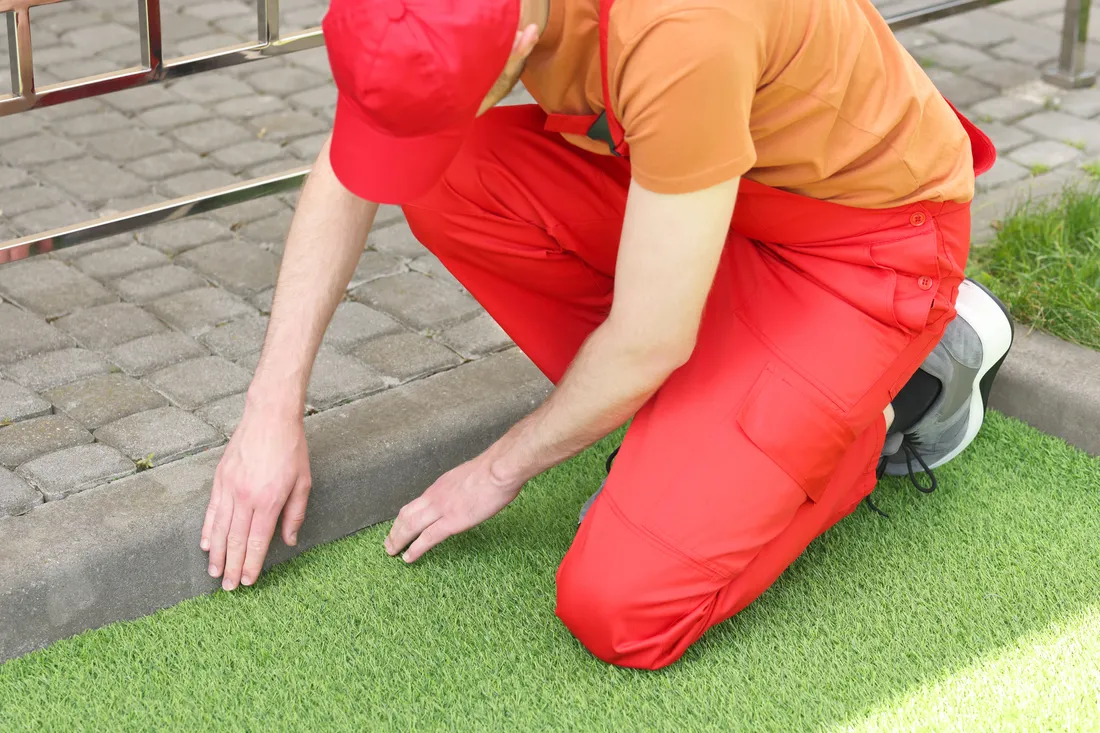
Lay, join and fix
Rolls relaxed, cut, and set with the grain all running one way. Joins trimmed back two stitch lines, butted rather than overlapped, taped from below with fibres kept clear of the adhesive. Perimeters pinned at roughly 300 to 400mm, or bonded where turf meets concrete.
- 5
Infill and brush
Kiln dried silica sand at around 10 to 15 kilograms per square metre, power-broomed through the pile so the blades stand up, the backing is shielded and the joins disappear.
What the ground under the Hunter actually does
This is the part a national franchise script cannot give you, and it is published, free and specific. The NSW soil landscape reports describe each mapped unit in the region in the government's own words.
The Beresfield unit dominates Thornton (about 70 per cent of the suburb polygon), East Maitland (about 65 per cent) and Fletcher (about 59 per cent). Its rating: "Generally high foundation hazard due to moderate to high shrink-swell (reactive) and highly plastic subsoils", with subsoil limitations listed as "High plasticity; Moderate shrink-swell potential; Low permeability; Very strong acidity". Plastic, reactive, and it does not drain. That is the base design brief, written by the State.
The Warners Bay unit runs through Warners Bay itself (about 70 per cent), Charlestown (about 31 per cent) and Cameron Park (about 26 per cent), and carries the same language: "moderate to high shrink-swell, plastic subsoils", with "seasonal waterlogging and high run-on (localised, lower slopes)". Where the block sits on the slope changes the answer more than the suburb name does.
Then there are the units nobody expects. Fletcher is a near two-way split, with about 37 per cent mapped as Bobs Farm variant a, "deep (>300 cm), very poorly drained Humic Gleys" with "permanently high watertables" and potential acid sulfate soils that the report warns must not "be exposed to the air through drainage or excavation". That is a genuine constraint on excavation depth, not a footnote. And Medowie, seven tenths on its own named unit, is the friendliest ground in the region at "Generally low foundation hazard", with the report's single caveat that where indurated sandy deposits sit shallow, "excavation is difficult".
Two honest caveats. This mapping is at 1:100,000 scale, so it describes the suburb polygon including parks, roads and industrial land, not your particular backyard. And the reports describe themselves as an inventory of soil and landscape properties, not a substitute for a site inspection. They tell you which questions to ask. Only a digger answers them.
Where installs go wrong, and it is always the same place
Not the laying. Most competent people can cut, join and dress a small area neatly. It is the base: one compaction pass instead of two, road base depth guessed rather than measured, falls set by eye, a membrane skipped to save half an hour. None of that looks wrong on handover day. It surfaces twelve to eighteen months later as low spots that hold water, edges that lift, and a surface that feels spongy rather than firm. Independent consumer testing and Australian installation guides agree on this failure pattern, and on ground that does not drain it arrives sooner. If you are weighing up doing it yourself, we have set the two routes side by side in our comparison of retail rolls and a trade install.
Old blocks, new estates, and paved courtyards
Three job types dominate here and they are priced differently for good reason.
Established blocks across the inner suburbs and the lake villages tend to be larger, with levels that have shifted over decades and a reasonable chance of old paths, footings, fill or forgotten services under the lawn. Belmont is the extreme case: nearly 12 per cent of the suburb is mapped as Disturbed Terrain, artificial fill described as "unconsolidated low wet bearing strength materials" with "impermeable soils, poor drainage". East Maitland carries 4.9 per cent of the same. Where fill is present the report itself recommends geotechnical engineering advice before development approval, which is a strong hint about how confidently anyone should be quoting from a photo.
New estate yards at Cameron Park, Thornton and the newer Maitland releases are the opposite: graded within the last decade, small, square, and predictable to excavate. The rate per square metre is usually higher and the total lower, because the fixed costs of a job do not shrink with the area. Access is generally better, which speeds the whole thing up.
Paved courtyards skip excavation entirely, because the slab is already the base. Turf is bonded down with adhesive over a thin foam underlay rather than pinned, and the whole question becomes where water leaves. We cover that job on its own page, laying turf over an existing slab.
What to have written into the quote
Excavation depth in millimetres. Base material and how many compaction passes it gets. Where water is designed to go, and by what route. Edge restraint detail and fixing spacing. Infill rate in kilograms per square metre. Turf specified by pile height, backing type and warranty term rather than by product name alone. Spoil disposal and tipping fees, stated as included or excluded. Every item on that list disappears from view the day the job finishes. That is exactly the argument for putting it on paper first. Our Hunter cost breakdown by tier gives you the numbers to hold it against, and the full laying guide goes deeper on each stage.
Installation questions from Hunter homeowners
How deep does the base need to go on Hunter clay?
There is no Australian Standard that sets excavation depth for artificial turf as a function of soil type, and anyone who tells you otherwise is inventing it. What the soil reports do establish is the problem the base has to solve. On the Beresfield unit under Thornton, East Maitland and much of Fletcher, the subsoil is listed with "Low permeability" and "moderate to high shrink-swell", which means water will not disappear downwards and the ground itself moves. The practical answer is a properly compacted free-draining layer graded to a fall that reaches a real outlet, with the depth set by what the installer finds on the day.
Will they need to bring machinery through the house?
Not through the house, but access decides whether it is a machine job or a barrow job, and that changes the labour hours more than most people expect. On the newer estates at Cameron Park, Thornton and around Maitland, side access is usually generous enough for a mini excavator. On older inner Newcastle blocks a 900mm side gate and a set of steps means every tonne of road base and every barrow of spoil goes through by hand. Point that out when you request a quote so the number you get back is real.
Does AS 2870 apply to my turf install?
No. AS 2870 is the residential footings and slabs standard, called up by the National Construction Code for footings and slabs of houses, garages and sheds. It is not a landscaping standard and it imposes nothing on a turf installer. It is worth knowing about only because it classifies building sites by soil reactivity, and the same soil properties that concern a slab designer, shrink-swell and permeability, are the ones that govern drainage under a turf base.
What about the Mine Subsidence District listings I have seen?
Several of the NSW soil landscape unit reports covering this region list "Mine Subsidence District" as a landscape limitation. That is a planning designation rather than a soil property, and it is not something a turf website should be interpreting for your block. If it applies to your property it is a question for the relevant authority and your council, not for an installer.
How long does an install take?
It depends on area, ground conditions and access, which is precisely why a real quote comes with a firm timeframe attached rather than a generic promise. No Australian installer publishes reliable per-job timeframes, so we are not going to make one up. Ask for a start-to-finish estimate once the installer has walked the site.
Can the crew work around an established tree?
Usually yes, and on older Newcastle and Lake Macquarie blocks it comes up constantly, because the good shade is often the reason the lawn underneath died in the first place. Root zones limit how deep you can excavate, so the detail around the trunk gets designed rather than assumed. Raise it early: shade is also the single most effective thing you have for keeping the surface temperature down, so a mature tree over part of the lawn is an asset, not an obstacle.
Do I need council approval to install turf in my own yard?
For turf behind your own boundary, approval is not normally the issue anywhere in the Hunter. The restrictions that do exist concern the verge, which is Council land. Lake Macquarie's Verge Garden Standards state a verge garden "must not include artificial turf". Port Stephens requires approval for any works in the road reserve. City of Newcastle publishes no position on turf, and Maitland has no verge policy at all. If any part of your job crosses the boundary onto the strip, check with your own council before ordering anything.
Have someone look at the actual ground
Send the suburb, rough size and how the crew would get to the yard. One vetted local installer will measure it up and give you an itemised price. Free, no obligation.
Get a free, no-obligation quote
Tell us a little about your job and we'll pass it to a vetted local installer.