
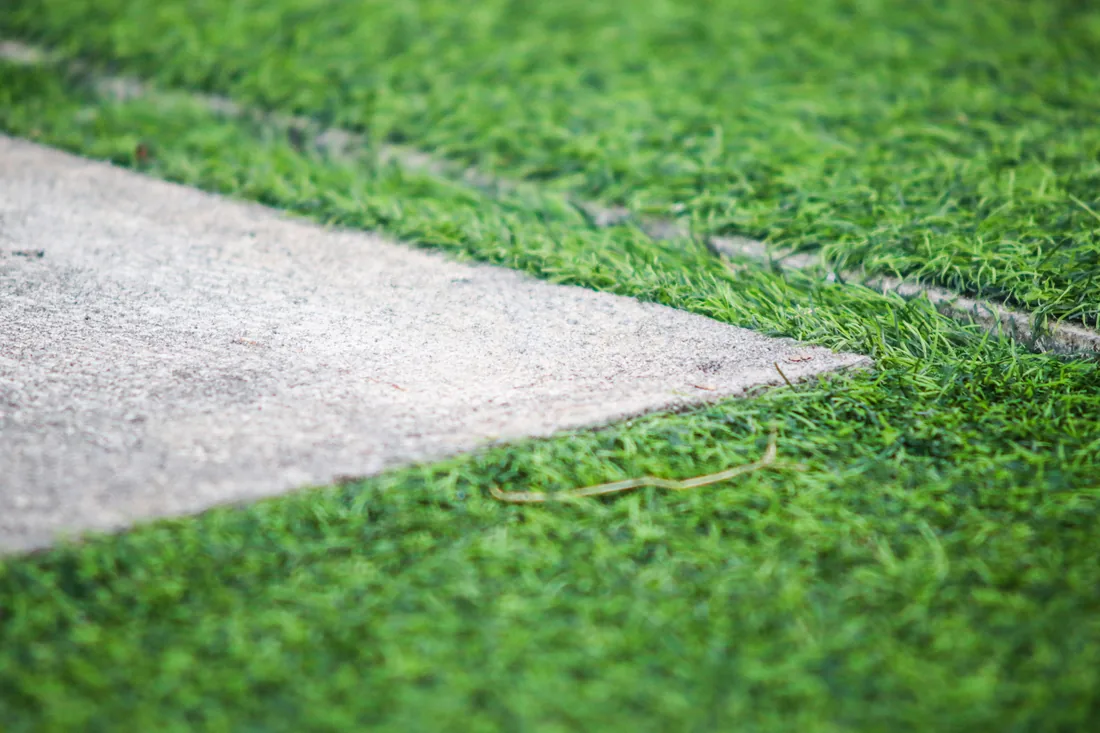
Why the Hunter has so many of these jobs
Two reasons, and they come from opposite ends of the housing stock. The older inner suburbs are full of narrow rear courtyards that were concreted decades ago, back when a paved yard was the low-maintenance answer, and are now a hot grey rectangle nobody uses. And the newer townhouse and unit stock across the region hands you a small paved terrace as the entire outdoor space. Neither has room for excavation, spoil removal and a compactor, and neither needs it.
There is a third case worth naming, because it is specific to this region. On blocks where the mapping flags fill or a high watertable, a slab that already exists and already drains can be a more predictable surface to build on than the ground beside it. That is not a general rule, and it is not a reason to concrete a lawn. It is simply a reminder that on some Hunter blocks the existing hard surface is the least uncertain part of the property.
The method, which is short
- Assess the fall. Before anything else, establish which way the slab drains and where the water exits. A slab with a fall to an open edge or a grate is straightforward. A dead-level slab, or one that falls toward the house, needs a drainage layer designed in or it should not proceed as-is.
- Clean and prepare. The surface is swept and cleaned so adhesive bonds properly. Loose material, oil and flaking sealer all compromise the bond.
- Underlay. A foam underlay of around 5mm is typically laid first. It softens the surface underfoot, which matters a lot on concrete, and evens out minor imperfections. Where drainage needs help, a drainage cell or dimpled mat creates a path for water under the turf.
- Bond, do not pin. Turf adhesive replaces pegs, because there is nothing to peg into. Perimeters and joins are the critical bonded areas, and on a windy or exposed site the edge detail is what stops the whole thing lifting.
- Joins and infill. Joins are trimmed, butted and taped as they would be on a lawn, with fibres kept clear of the adhesive. Infill still goes in: it weighs the turf down and stands the blades up, and on a bonded install the ballast against wind lift is doing real work.
What is missing from that list is instructive. No excavation, no road base, no compaction plant, no spoil truck. On a standard lawn those items carry roughly 30 per cent of the job. That is why a slab job prices differently, and why the comparison to a full lawn install is not apples to apples.
Humidity, shade and the mould question
Mould and mildew under turf is a real problem in humid Australian conditions, and it happens where drainage is blocked or the fall is poor, usually made worse by shade. Newcastle qualifies as humid: the Bureau of Meteorology's long Nobbys Signal Station record shows January and February overnight minimums holding above 19C, which is the warm-night coastal signature, and March through June each average above 115mm of rain. A shaded courtyard on a level slab in a wet autumn is the exact set of conditions that causes trouble.
The prevention is unglamorous: make sure the water has a path and an exit, and clear leaves and debris before they compost into the pile and block it. A courtyard with a tree over it needs the debris cleared more often, not less. That is a maintenance schedule rather than a reason to avoid the job.
If it is a strata balcony or courtyard, read this first
Here is a finding that most pages on this topic get wrong: there is no Australian statute, regulation, model by-law or reported tribunal decision that mentions artificial turf on a balcony. Not one. Everything turns on general strata provisions about common property, floor coverings, waterproofing and external appearance, and on two things that vary building by building: what the registered strata plan says the lot boundary is, and what your scheme's registered by-laws say. Any page that tells you flatly that you can or cannot lay turf on a balcony in New South Wales is wrong.
What can be set out is the framework. Under the Strata Schemes Development Act 2015 (NSW), the default horizontal boundary is the upper surface of the floor, which puts the slab and the waterproof membrane below it in common property, although a floor plan can define boundaries differently and many balconies are drawn outside the lot entirely. Under the Strata Schemes Management Act 2015, cosmetic work under section 109 expressly includes laying carpet, and minor renovations under section 110 expressly include installing hard floors, but both categories carry the same exclusions: work that changes the external appearance of a lot, and work involving waterproofing. Fair Trading puts it plainly, that minor renovations cannot change the outside or structure of a strata property or require waterproofing. Knock a job out of both categories and you land in section 111, which requires an approval by special resolution.
Practically, that means an exposed balcony visible from outside is very likely a section 111 conversation, while a fully enclosed courtyard not visible from outside, laid loose with no adhesive and the membrane untouched, has a plausible argument for being cosmetic by analogy with laying carpet. That argument is untested and no case decides it, so treat it as a position to raise with your owners corporation rather than a conclusion.
Two practical takeaways worth more than the theory. First, gluing changes the analysis, because adhesive attaches the work to common property. In one NSW tribunal matter concerning a balcony renovation, the pre-existing artificial turf was accepted without contest as not glued or otherwise affixed to the deck, while the membrane the owner later applied was found to be affixed to common property and unauthorised. Second, in that same matter, a strata manager's letter of consent was held not to constitute a special resolution. If somebody in your building tells you the strata manager has said it is fine, that is not approval, and it will not help you if there is a leak later.
Concrete, paving and balcony questions
Can turf go straight onto concrete without any base?
Yes, because the slab is the base. There is no excavation, no road base and no compaction. The turf is bonded down with turf adhesive rather than pinned, usually over a foam underlay of around 5mm that softens the surface underfoot and evens out minor imperfections in the concrete. That is a genuinely different job from a lawn install, and it should be priced as one.
What happens to the water?
This is the only question that really matters, and it is decided before anyone orders material. The slab needs a fall and somewhere for water to exit. If the concrete sits dead level, or falls towards a wall, water will sit under the turf. The usual fixes are a drainage cell or dimpled drainage mat under the underlay to create a path, or accepting that a particular slab is not a candidate until the fall is corrected. Ask any installer to tell you where the water leaves before they tell you the price.
Will it smell or go mouldy underneath?
Only if water is trapped and cannot get out, which is why the drainage question comes first. Mould and mildew under turf is a documented problem in humid Australian conditions where drainage is blocked or the fall is poor, and Newcastle summers are humid, with January and February overnight minimums holding above 19C on the long Nobbys record. On a slab that drains and a lawn that gets debris cleared, it is a non-issue. On a level slab in a shaded corner with leaves left to compost in the pile, it is a matter of time.
Does it work over pavers as well as poured concrete?
Generally yes, with an extra caution. Pavers move independently and joints telegraph through a thin underlay as visible lines. A thicker or better-quality underlay helps, and badly settled pavers are worth relaying first. The same applies to a cracked or stepped slab: turf conceals colour, it does not conceal level changes.
How does this work on a strata balcony or courtyard?
Legally rather than technically, and the honest answer is that it depends on your building. There is no Australian statute, regulation, model by-law or reported tribunal decision that mentions artificial turf on a balcony. The position comes from general strata provisions about common property, floor coverings, waterproofing and external appearance, and it turns on what your registered strata plan says the lot boundary is and what your scheme's by-laws say. Anyone who tells you flatly that you can or cannot is guessing. There is more detail below.
Is glued turf a problem when I sell or move out?
It is a fair question to ask before the adhesive comes out, particularly in a strata setting. Adhesive bonds the turf to the surface below it, and in a strata context that is precisely the fact that can convert a cosmetic change into work on common property. If reversibility matters to you, discuss a loose-laid or weighted approach with the installer before the job rather than after, and understand that a loose lay on an exposed windy balcony has its own limits.
Does a paved courtyard cost less per square metre than a lawn?
Less on the groundworks, more on the rate. There is no excavation, no road base and no spoil to cart away, which removes a substantial slice of a normal job. Against that, courtyards are small, and the fixed costs of getting a crew and materials to site do not shrink with the area, so the effective rate per square metre climbs. Published Australian pricing for balcony and rooftop work sits above standard residential, in the region of $90 to $150 per square metre installed, because membrane and drainage cell work is often part of it.
Send a photo of the slab and its fall
Courtyard jobs are quick to price once someone can see which way the water runs. One vetted local installer, free quote, no obligation.
Get a free, no-obligation quote
Tell us a little about your job and we'll pass it to a vetted local installer.